Saturday, November 15, 2008

Obama in the Green House

As the Obama presidency begins to take shape, those of us in the environmental movement—leaders of green nonprofits across the country—are eagerly awaiting the new administration. And while everyone is breathlessly second guessing everything from who might join his cabinet to which puppy his girls should adopt, let’s make one incredibly safe assumption. When all is said and done, Barack Obama will go down as the greenest president ever.

And not because he wants to. Because he has to.

Consider this: name the single most important president in the history of the environment. No, not Teddy Roosevelt, even though he named the first national park, started the National Park Service, and founded 51 wildlife refuges (he's pictured here with Sierra Club founder John Muir in Yosemite in 1903). Not Jimmy Carter, who set aside 130 million acres of Alaska and put solar panels on the White House (which Ronald Reagan famously removed).

Surprise, the most effective environmental president of all time—by far—is still Richard Nixon. In his six years in office, Nixon presided over a startling number of eco-accomplishments: the creation of the EPA and the White House Council on Environmental Quality, bans on DDT and lead in gasoline, and the passage of an unprecedented raft of legislation including the Endangered Species Act, Clean Air and Clean Water acts, the National Environmental Policy Act (which begat environmental impact statements), and more.

And Nixon did all this not because he wanted to. Because he had to. Nixon took office in January 1969 at the height of the nascent environmental movement’s powers. Cleveland’s Cuyahoga River had caught fire (twice, actually), Lake Erie was declared biologically dead, smokestacks in cities nationwide were spewing everything, and bald eagles, peregrine falcons, and brown pelicans were vanishing from egg-shell thinning courtesy of DDT. Rachel Carson’s Silent Spring and Paul Ehrlich’s Population Bomb were clarion calls to action, and 1970’s first Earth Day was then the largest demonstration in American history.

Nixon saw where this was all heading, and to ensure his political future, became Chief Environmentalist.

Obama is coming to the presidency precisely at another watershed moment for the environment. The earth is warming as atmospheric dioxide concentrations continue to climb with devastating consequences: sea levels are rising, storms increasing, species disappearing at record levels,
forest fires raging (like this week's California , a photo of which is here) deserts and diseases spreading, coral reefs bleaching and dying. Just this week, the island nation of Maldives, only three feet above sea level, announced it is shopping for real estate in Sri Lanka or India just in case it drowns under a warming ocean. Global CO2 concentrations, historically at 280 parts per million, are fast approaching 400 ppm, while the emerging scientific consensus recommends hauling concentrations back to 350 or below.

And there’s one key difference between 1970 and today: Nixon’s problems were seen as local. Restore Lake Erie. Clean that smokestack. Today’s problems are hugely, unforgivably global.

But global climate change is just the first of the ecological twin towers confronting us and Obama. The emerging freshwater crisis, exacerbated by climate change, is only starting to get the attention it deserves, and will soon burst onto Page One as weather patterns continue drying key bodies of water. Many of the world’s largest rivers—the Colorado, Nile, Ganges, Yellow—barely reach the sea in dry seasons, and water scarcity is playing a significant role in the unfolding Darfur crisis. Want peace in the Middle East? You’ll have to solve Palestinian access to water first.

To his credit, Obama sees the writing on the wall. In his Grant Park victory speech, he recognized the short list of issues confronting his presidency. “For even as we celebrate tonight,” he intoned last Tuesday night, “we know the challenges that tomorrow will bring are the greatest of our lifetime—two wars, a planet in peril, the worst financial crisis in a century.” And during the debates, when moderators asked which programs he’d give up as the economy collapsed, Obama adamantly reasserted his belief that green collar jobs like building wind turbines, weatherizing houses and installing solar panels were a centerpiece of his emerging economic agenda, and would NOT be cut. Let’s see.

Not surprisingly, environmental leaders, starved for action, are quickly pushing and pulling at Obama. Al Gore and his “
We” campaign advocate weaning us completely off fossil fuels in 10 years. Author Bill McKibben, leader of the new 350.org, a reference to CO2 concentrations, has lobbied the president-elect to head to Poland in December for upcoming climate talks. And the entire green community is salivating over the possibility of the US revisiting the Kyoto protocol.

What will Obama do? The likely short list includes a radically new energy policy, a reinvigorated EPA and Interior, new protections for old growth forests and endangered ecosystems, an international climate treaty of some kind, a revived and greener Detroit, a continued greening of architecture, schools, businesses, and the marketplace, new wilderness areas, enhanced recycling, and a stronger endangered species act.

For like Nixon in 1969, one sees the unfolding arc of the environmental story. On the campaign, Obama frequently cited Martin Luther King’s “fierce urgency of now,” referring to his own candidacy as much as anything else. And without question there is a fierce urgency to economic realties—in fact, many will urge Obama to derail a green agenda for the sake of the economy.

But there is a fierce urgency to the planet’s situation—and the data will continue to unrelentingly point in even gloomier directions. The planet is ecologically unraveling, and a tsunami of public support will demand critical action.

And Obama will respond. Not because he wants to, even though he might. Because he has to. And if McCain had win last week, I'd be writing the same words.

“We’ve only got four minutes to save the world,” sings Madonna. We might have a little longer than that. Four years—his first term—sounds about right.

Thursday, November 6, 2008

The Power of Green

Obama and McCain talked about it for months, as did Hillary.

T. Boone Pickens never stops talking about it, in TV commercials and web sites.

Everyone’s talking about green collar jobs, one of the very few glimmers on an increasingly gloomy economic scene. And after a week when the Dow sheds points like the
maple outside my window drops leaves, we need good news.

In fact, when pressed in the last two debates about what he’d cut from his ambitious platform of middle class tax cuts, health care reform, and more, now president-elect Obama went out of his way to say he would make sure he did NOT cut spending on new energy sources like wind and solar, because that’s where the jobs are.

And the UN agrees.
A report earlier this fall revealed that there are millions of jobs to be had in the emerging green economy. Among the report’s findings:

The global market for environmental products and services is projected to double from $1.37 trillion per year at present to $2.74 trillion by 2020.

Half of this market is in energy efficiency and the balance in sustainable transport, water supply, sanitation and waste management.

Clean technologies are already the third largest sector for venture capital after information and biotechnology in the United States, while green venture capital in China more than doubled to 19% of total investment in recent years.

2.3 million people have in recent years found new jobs in the renewable energy sector alone, and the potential for job growth in the sector is huge. Employment in alternative energies may rise to 2.1 million in wind and 6.3 million in solar power by 2030.

And this is key: Renewable energy generates more jobs than employment in fossil fuels.

Projected investments of $630 billion by 2030 would translate into at least 20 million additional jobs in the renewable energy sector.

That’s the ticket, putting people back to work installing solar panels, building wind turbines, planting green roofs, insulating and re-wiring houses, and more.

The power of green: the greening of the economy will be led by a, well, greening of the economy.

Wednesday, November 5, 2008

Obama on the Environment: Amen!

“For even as we celebrate tonight,” president-elect Barack Obama noted as he presented his valedictory in Chicago early this morning, “we know the challenges that tomorrow will bring are the greatest of our lifetime—two wars, a planet in peril, the worst financial crisis in a century.”

There: he said it. “A planet in peril.” At long last, an American president stated the obvious, and it’s tucked into the top of a very short to-do list.

As a naturalist and environmental educator, you can’t believe what this means to me.

The race is on, to cool the climate, save species, preserve forests and fields, green the economy, find the sustainable, softer path on water, energy, business.

But can we win this race?

By now, you know the answer: yes we can. We have no choice.

Savor the moment—but tomorrow, let’s roll up our sleeves.


Friday, October 24, 2008

The Sinking Ark: Vanishing Mammals

This blog was begun to celebrate and advocate for nature, with emphasis on celebrate—we just don’t do that enough.

But today, we’ll leave the celebrating for another day: A recent United Nations study, as reported in many places (like here) fully one quarter of the world's mammals are threatened with extinction by 2030. That's 25% of the world's 5,600 mammals.

As if that wasn’t sobering enough, the study also found that half of all were in decline. Jan Schipper, the scientist who led the study, said threats were worst for land mammals in Asia, where creatures such as orangutans (left) are suffering from deforestation. Almost 80 percent of primates in that region are in trouble.

One of the most threatened includes the Iberian lynx, for which there are only some 100 left. But such notables as the Tasmanian devil, black rhino, and Siberian tiger are also in steep decline. The little earth hutia of Cuba has not been seen in 40 years; the polar bear is rising in concern as Arctic ice melts seemingly before our eyes.

At least 76 mammals have gone extinct since 1500.

No surprise: habitat loss, hunting and now climate change are big factors in the loss.

"Within our lifetime hundreds of species could be lost as a result of our own actions," said Julia Marton-Lefevre, director general of the International Union for Conservation of Nature (IUCN).

OK, there’s a slim glimmer of hope: five percent of species are recovering because of conservation efforts, including the black-footed ferret; the African elephant was also moved down one notch of risk, from "vulnerable" to "near threatened." Amazingly, almost 350 new species of mammals have been found since 1992, such as the elephant shrew in Tanzania, it said.

There’s a cruel irony: species are likely vanishing before they are even described.

So we’ve got work to do. As Martin Luther King said in a different context, there is a “fierce urgency of now.”

Tuesday, October 21, 2008

Leaf Them Alone! Two Reasons to Rake Less Leaves

Fall: cold, crisp weather, shorter days, and leaves turning stunning colors.

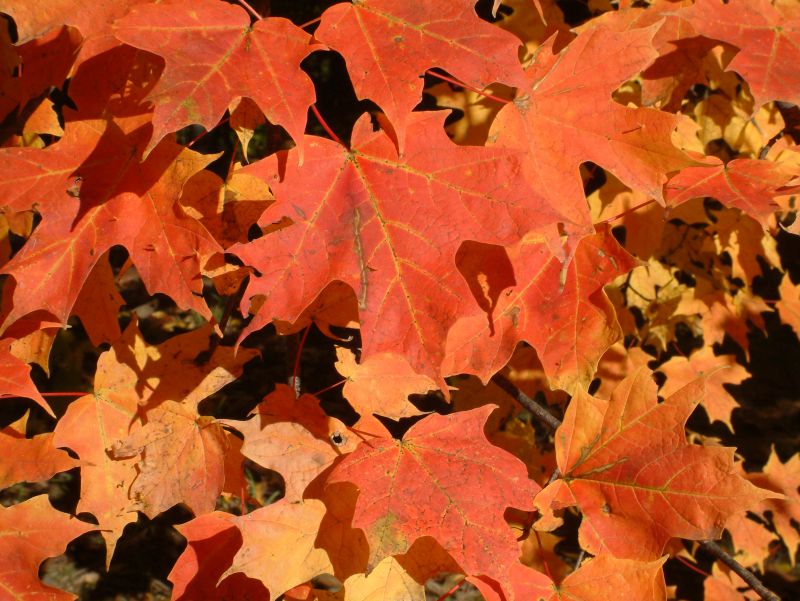
There's a massive sugar maple turning an extraordinary red-orange not far from my house. You’ve got to see this one—sugar maples are among the area’s showiest fall colors anyway (photo below), and this is one of the best sugar maples I’ve ever seen. In fact, the sugar maple color is so unique it belongs in a Crayola crayon box.

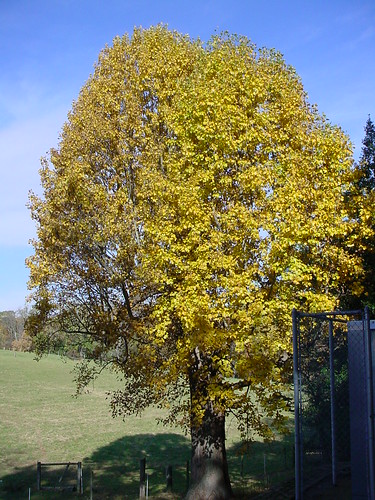
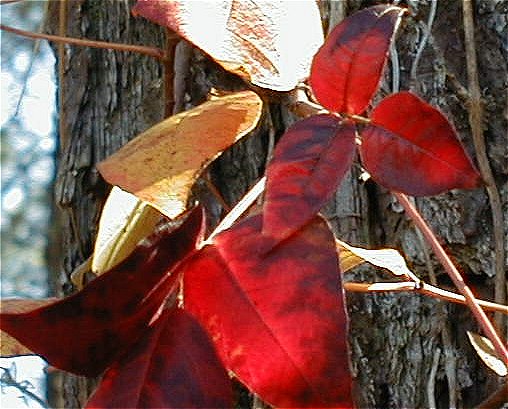
Tuliptrees, the largest trees in local forests, are busily brightening yellow, dogwoods slide into a beautiful deep burgundy, sassafras glows bronzy orange with hints of purple, and believe it or not, poison ivy turns the purest red in nature’s fall palette. Each tree turns its own characteristic color in the fall season.

But even as the trees complete this miracle, something else happens to their leaves: they drop. It’s why we call it fall. Between now and the end of the year, we’ll fill uncountable numbers of big brown leaf bags. It is simply amazing— discouraging, even—how many leaves fall from a single tree.

So by Thanksgiving, we’re sick of leaves, sick of raking, sick of the unending dreary brown of dead leaves that cover the landscape. And for many of us, the neatening genes kick in, and we want to gather and get rid of all those wet, decomposing leaves that suffocate our suburban lawns.

But wait.

This year, I invite you to join me in a very special, almost anarchic, act: rake less leaves this fall. Leave piles of leaves in corners or sections of your lawn and garden, if you can. For two reasons, one more obvious than the other.

More obvious: those leaves falling off your trees are filled with the exact nutrients in the perfect combinations that your lawns need as nutrition. Amazingly, we pay people to blow every leaf off our precious green lawn, then pay someone else to pour buckets of nutrient-rich fertilizers onto those same nutrient-starved lawns, most of which runs off the property when the first rainfall comes anyway. We burn a lot of bucks this way.

We’d save tons of time, energy and money if the nutrients stored in those leaves were simply put back directly where they belong—on your lawn. Use a mulching mower to chop them (much more effective when the leaves are dry than wet), and leave them in place. The small particles of leaves will happily decompose into your lawn—and feed your grass. Some people compost their leaves, which is also fine—but few then use the resulting compost. Mulching in place saves incredible amounts of precious energy while feeding the lawn organically, skipping fertilizers made from petrochemicals.

Mulching promotes energy conservation and cools the climate.

Less obvious reason: yesterday, I spotted a Monarch butterfly flitting across a meadow. Normally a happy sight, seeing one this late in the fall made me sad—Monarchs overwinter in Mexican mountain valleys, and as the first Monarchs usually show up in Mexico around Halloween, this dude should have been much farther south by now, and I don’t think it’s going to reach Mexico for the winter.

But countless other insects like beetles, wasps, bees and butterflies—the same creatures that literally hold up the world—hibernate in one stage of their life cycle, tucked away in nooks and crannies of our fields and forests. Many burrow beneath piles of leaves, using them as blankets of insulation, and sleep the winter away. Ladybugs hibernate as larvae, praying mantises as egg cases, tiger swallowtails as cocoons: each insect survives the winter in only one stage of its life cycle, and each insect has picked a different stage.

So when landscapers leaf-blow our gardens, or when we meticulously rake every leaf off our lawns, we are disturbing and even killing countless numbers of overwintering insects, trucking them off to the leaf dump to be buried beneath tons of debris. And there is a cost.

Fireflies, for example, are becoming increasingly rare in American suburbs, partly because of too much light at night—they can’t see each other with all our security lights—and partly because too many lawns are too well manicured. They have no place to overwinter.

While it drives one of my daughters crazy, I am deliberately a lazy gardener, leaving corners and beds loaded with leaves, Mother Nature’s mulch, not raking them up but letting them be. They slowly decompose during the winter, slowly releasing their nutrients into my flower beds, providing sleeping places for butterflies, bees and bugs.

Messy gardening promotes biological diversity.

With all our discussions about living green, there are so many actions you can take, from aggressively recycling to purchasing an electric car. But also on the list is changing our gardening habits. So leave those leaves, wherever you can, conserving energy and allowing creatures great and small their winter hiding places.

Friday, September 19, 2008

A Warming World: More Hurricanes Like Ike?


In the wake of Hurricane Ike’s devastating hit on Galveston and the Gulf Coast, discussion swirls around the role of global warming in creating both more and larger hurricanes.


As I noted today on WHYY’s “Morning Edition,” you can’t pin any one hurricane on global warming. But you can look for long-term trends.

So the
Pew Center for Climate Change has discovered that between 1850 and 1990, there were, on average, 10 tropical storms in the North Atlantic annually, five of which became hurricanes.

Since 1995, the average number has jumped to 14, eight of which were hurricanes. The North Atlantic shows an increase in hurricane activity in the last decade, a possible fingerprint for global warming.

But don’t get cocky: oddly enough, there is no evidence for more hurricanes worldwide. So scientists continue to wring their hands over evidence.

Still, the UN’s
Intergovernmental Panel on Climate Change, the group that won the Nobel Peace Prize alongside Al Gore, weighed in last year: the probability that GW makes more hurricanes “is more likely than not.” A tepid but appropriate response as science continues to weigh the evidence.

Meanwhile, the
National Wildlife Federation has just released a study that says that when hurricanes do form, global warming gives them a three-fold wallop:

Hurricanes will be stronger with more winds.

They will bring heavier rainfall.

And they will cause more flooding because of a larger storm surge.

Their data says a warmed atmosphere over a warmed ocean—the fuel that powers hurricanes—will push wind speeds up some 13%, nudging some storms from dangerous Category 3 to catastrophic Katrina-level Category 4.

Rainfall can increase between 10 and 31% over normal; Hurricane Fay, the one that managed to hit Florida four times, a record, dropped 27 inches of rain in some places. 27 inches: almost what Philadelphia gets in a full year!

And Ike traveled north after Galveston, dropping nine inches of rain in Chicago a couple of days later, causing horrific flooding up there.

And if powerful winds push storm surges higher, there will be more flood damage. Since 1998, some dozen hurricanes have topped $1 billion in damage, capped by Katrina, raining down $125 billion in destruction. Who knows what Ike’s bill will be; the costs mount daily.

To mitigate flood damage, NW reminds us that beaches were once the barriers that protected the mainland from storms—the loss of wetlands in New Orleans exacerbated Katrina’s damage. They are sponges that absorb storm surges and excess water.

Every mile of healthy wetlands, they say, can trim 3-9 inches off a storm surge. Yet wetlands continue to vanish under an assault of development.

And one acre of wetlands reduces hurricane damage by $3,300. String together thousands of acres, and you’ve got something. In fact, Texas and Galveston have begun an intense debate on whether or not homeowners can rebuild on the barrier beaches.

Let’s first just acknowledge that in the last 20 years, there has been a building boom on beaches—a potential accident waiting to happen.

The impact of global warming on hurricanes is, of course, controversial in some circles: just check out the web site of
RealClimate.org for starters.

No matter how you feel about the issue, this is a critically important discussion, and the defining era of this, the Greenhouse Age.

Friday, August 8, 2008

Carbon Sequestration: A High Tech Hail Mary

Even with the price of gas beginning to drop from historic highs (a gallon of unleaded regular is $3.89 this week outside Philly), energy remains one of the top stories of the summer. In fact, it’s astonishing that a price below four bucks suddenly seems reasonable.

And with Big Oil openly acknowledging that the age of Black Gold is ending (BP, after all, reminds us its initials now stand for Beyond Petroleum), entrenched fossil fuel interests are doing whatever they can to grab the last few straws—drill in the Arctic Circle, drill offshore, drill anywhere…

While oil reserves are dwindling, everyone acknowledges there are massive coal seams across the United States. To get us to energy independence, Big Coal is
working overtime to convince us that coal is, or can be, clean (unlike the stacks pictured here). There are aggressive advertising campaigns on TV polishing coal’s image, and lots of high-tech research going on.

This summer,
the EPA has announced a high-tech solution to global warming—it has authorized a new class of deep-injection wells for pumping highly pressurized, liquified carbon dioxide for permanent storage.

In other words, keep burning coal, the dirtiest of fuels, but don’t worry about global warming: just capture the CO2, inject it into wells, and store it there in perpetuity.

Forever is a long time.

Coal executives crow that their power plants can thus become carbon neutral: they’ll sequester 90% of the emissions and plant trees to offset the final 10%, the hardest part to capture.

At face value, this sounds good, and EPA says “sequestration will play a major role in reducing CO2 emissions.” But a
growing chorus of voices is reminding us of some of the downsides of sequestration.

First, whatever formations the highly pressurized, very cold, liquefied carbon dioxide is injected into have to be highly stable—imagine injecting it into wells here, only to have it leak out of fissures in the rock over there, defeating the purpose at great price to both economy and ecology.

Then, creating the high-pressure injectable fluid is itself an energy-intensive project; the sequestration plants might increase the plant’s energy needs by as much as 40%. And the sequestration plants themselves create smog and burn oil in injecting the gas.

Third, one doesn’t sequester the CO2 in the rock right below the power plant. Pipelines must be built to bring the liquefied stuff to the injection point hundreds of miles away.

So we have a high-tech shell game of moving carbon dioxide around at great expense—so that coal remains in play as an energy source.

Big Coal sees that the clock ticking; time is running out.
Thomas Friedman of the New York Times reminds us we’re looking for 21st century solutions, and coal is a 19th century fuel. Coal is akin to whale oil—yes, we can burn it, but at what cost?

As one studies the entire energy picture, sequestration seems a Hail Mary pass the coal hopes will buy it more time.

But it’s not the future. The future is clean and green, and we need to begin moving there far more rapidly than we currently are.