Friday, October 24, 2008

The Sinking Ark: Vanishing Mammals

This blog was begun to celebrate and advocate for nature, with emphasis on celebrate—we just don’t do that enough.

But today, we’ll leave the celebrating for another day: A recent United Nations study, as reported in many places (like here) fully one quarter of the world's mammals are threatened with extinction by 2030. That's 25% of the world's 5,600 mammals.

As if that wasn’t sobering enough, the study also found that half of all were in decline. Jan Schipper, the scientist who led the study, said threats were worst for land mammals in Asia, where creatures such as orangutans (left) are suffering from deforestation. Almost 80 percent of primates in that region are in trouble.

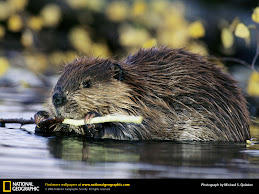
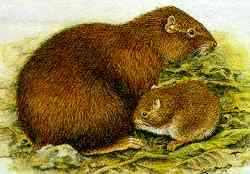
One of the most threatened includes the Iberian lynx, for which there are only some 100 left. But such notables as the Tasmanian devil, black rhino, and Siberian tiger are also in steep decline. The little earth hutia of Cuba has not been seen in 40 years; the polar bear is rising in concern as Arctic ice melts seemingly before our eyes.

At least 76 mammals have gone extinct since 1500.

No surprise: habitat loss, hunting and now climate change are big factors in the loss.

"Within our lifetime hundreds of species could be lost as a result of our own actions," said Julia Marton-Lefevre, director general of the International Union for Conservation of Nature (IUCN).

OK, there’s a slim glimmer of hope: five percent of species are recovering because of conservation efforts, including the black-footed ferret; the African elephant was also moved down one notch of risk, from "vulnerable" to "near threatened." Amazingly, almost 350 new species of mammals have been found since 1992, such as the elephant shrew in Tanzania, it said.

There’s a cruel irony: species are likely vanishing before they are even described.

So we’ve got work to do. As Martin Luther King said in a different context, there is a “fierce urgency of now.”

Tuesday, October 21, 2008

Leaf Them Alone! Two Reasons to Rake Less Leaves

Fall: cold, crisp weather, shorter days, and leaves turning stunning colors.

There's a massive sugar maple turning an extraordinary red-orange not far from my house. You’ve got to see this one—sugar maples are among the area’s showiest fall colors anyway (photo below), and this is one of the best sugar maples I’ve ever seen. In fact, the sugar maple color is so unique it belongs in a Crayola crayon box.

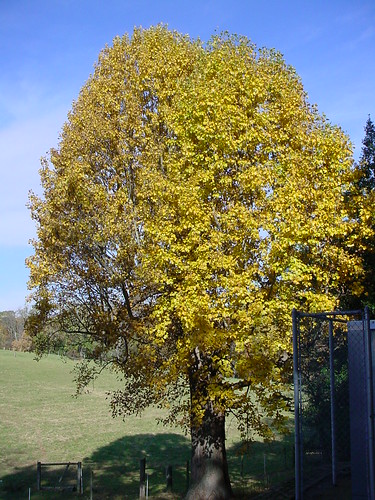
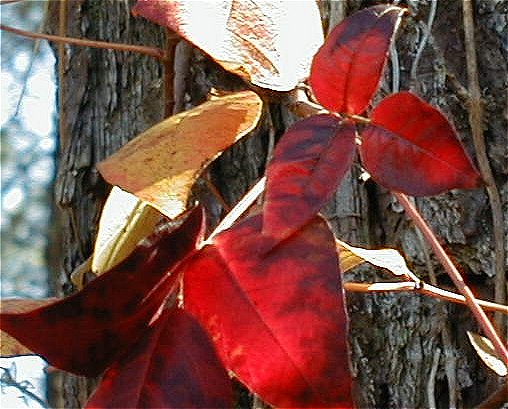
Tuliptrees, the largest trees in local forests, are busily brightening yellow, dogwoods slide into a beautiful deep burgundy, sassafras glows bronzy orange with hints of purple, and believe it or not, poison ivy turns the purest red in nature’s fall palette. Each tree turns its own characteristic color in the fall season.

But even as the trees complete this miracle, something else happens to their leaves: they drop. It’s why we call it fall. Between now and the end of the year, we’ll fill uncountable numbers of big brown leaf bags. It is simply amazing— discouraging, even—how many leaves fall from a single tree.

So by Thanksgiving, we’re sick of leaves, sick of raking, sick of the unending dreary brown of dead leaves that cover the landscape. And for many of us, the neatening genes kick in, and we want to gather and get rid of all those wet, decomposing leaves that suffocate our suburban lawns.

But wait.

This year, I invite you to join me in a very special, almost anarchic, act: rake less leaves this fall. Leave piles of leaves in corners or sections of your lawn and garden, if you can. For two reasons, one more obvious than the other.

More obvious: those leaves falling off your trees are filled with the exact nutrients in the perfect combinations that your lawns need as nutrition. Amazingly, we pay people to blow every leaf off our precious green lawn, then pay someone else to pour buckets of nutrient-rich fertilizers onto those same nutrient-starved lawns, most of which runs off the property when the first rainfall comes anyway. We burn a lot of bucks this way.

We’d save tons of time, energy and money if the nutrients stored in those leaves were simply put back directly where they belong—on your lawn. Use a mulching mower to chop them (much more effective when the leaves are dry than wet), and leave them in place. The small particles of leaves will happily decompose into your lawn—and feed your grass. Some people compost their leaves, which is also fine—but few then use the resulting compost. Mulching in place saves incredible amounts of precious energy while feeding the lawn organically, skipping fertilizers made from petrochemicals.

Mulching promotes energy conservation and cools the climate.

Less obvious reason: yesterday, I spotted a Monarch butterfly flitting across a meadow. Normally a happy sight, seeing one this late in the fall made me sad—Monarchs overwinter in Mexican mountain valleys, and as the first Monarchs usually show up in Mexico around Halloween, this dude should have been much farther south by now, and I don’t think it’s going to reach Mexico for the winter.

But countless other insects like beetles, wasps, bees and butterflies—the same creatures that literally hold up the world—hibernate in one stage of their life cycle, tucked away in nooks and crannies of our fields and forests. Many burrow beneath piles of leaves, using them as blankets of insulation, and sleep the winter away. Ladybugs hibernate as larvae, praying mantises as egg cases, tiger swallowtails as cocoons: each insect survives the winter in only one stage of its life cycle, and each insect has picked a different stage.

So when landscapers leaf-blow our gardens, or when we meticulously rake every leaf off our lawns, we are disturbing and even killing countless numbers of overwintering insects, trucking them off to the leaf dump to be buried beneath tons of debris. And there is a cost.

Fireflies, for example, are becoming increasingly rare in American suburbs, partly because of too much light at night—they can’t see each other with all our security lights—and partly because too many lawns are too well manicured. They have no place to overwinter.

While it drives one of my daughters crazy, I am deliberately a lazy gardener, leaving corners and beds loaded with leaves, Mother Nature’s mulch, not raking them up but letting them be. They slowly decompose during the winter, slowly releasing their nutrients into my flower beds, providing sleeping places for butterflies, bees and bugs.

Messy gardening promotes biological diversity.

With all our discussions about living green, there are so many actions you can take, from aggressively recycling to purchasing an electric car. But also on the list is changing our gardening habits. So leave those leaves, wherever you can, conserving energy and allowing creatures great and small their winter hiding places.

Friday, September 19, 2008

A Warming World: More Hurricanes Like Ike?


In the wake of Hurricane Ike’s devastating hit on Galveston and the Gulf Coast, discussion swirls around the role of global warming in creating both more and larger hurricanes.


As I noted today on WHYY’s “Morning Edition,” you can’t pin any one hurricane on global warming. But you can look for long-term trends.

So the
Pew Center for Climate Change has discovered that between 1850 and 1990, there were, on average, 10 tropical storms in the North Atlantic annually, five of which became hurricanes.

Since 1995, the average number has jumped to 14, eight of which were hurricanes. The North Atlantic shows an increase in hurricane activity in the last decade, a possible fingerprint for global warming.

But don’t get cocky: oddly enough, there is no evidence for more hurricanes worldwide. So scientists continue to wring their hands over evidence.

Still, the UN’s
Intergovernmental Panel on Climate Change, the group that won the Nobel Peace Prize alongside Al Gore, weighed in last year: the probability that GW makes more hurricanes “is more likely than not.” A tepid but appropriate response as science continues to weigh the evidence.

Meanwhile, the
National Wildlife Federation has just released a study that says that when hurricanes do form, global warming gives them a three-fold wallop:

Hurricanes will be stronger with more winds.

They will bring heavier rainfall.

And they will cause more flooding because of a larger storm surge.

Their data says a warmed atmosphere over a warmed ocean—the fuel that powers hurricanes—will push wind speeds up some 13%, nudging some storms from dangerous Category 3 to catastrophic Katrina-level Category 4.

Rainfall can increase between 10 and 31% over normal; Hurricane Fay, the one that managed to hit Florida four times, a record, dropped 27 inches of rain in some places. 27 inches: almost what Philadelphia gets in a full year!

And Ike traveled north after Galveston, dropping nine inches of rain in Chicago a couple of days later, causing horrific flooding up there.

And if powerful winds push storm surges higher, there will be more flood damage. Since 1998, some dozen hurricanes have topped $1 billion in damage, capped by Katrina, raining down $125 billion in destruction. Who knows what Ike’s bill will be; the costs mount daily.

To mitigate flood damage, NW reminds us that beaches were once the barriers that protected the mainland from storms—the loss of wetlands in New Orleans exacerbated Katrina’s damage. They are sponges that absorb storm surges and excess water.

Every mile of healthy wetlands, they say, can trim 3-9 inches off a storm surge. Yet wetlands continue to vanish under an assault of development.

And one acre of wetlands reduces hurricane damage by $3,300. String together thousands of acres, and you’ve got something. In fact, Texas and Galveston have begun an intense debate on whether or not homeowners can rebuild on the barrier beaches.

Let’s first just acknowledge that in the last 20 years, there has been a building boom on beaches—a potential accident waiting to happen.

The impact of global warming on hurricanes is, of course, controversial in some circles: just check out the web site of
RealClimate.org for starters.

No matter how you feel about the issue, this is a critically important discussion, and the defining era of this, the Greenhouse Age.

Friday, August 8, 2008

Carbon Sequestration: A High Tech Hail Mary

Even with the price of gas beginning to drop from historic highs (a gallon of unleaded regular is $3.89 this week outside Philly), energy remains one of the top stories of the summer. In fact, it’s astonishing that a price below four bucks suddenly seems reasonable.

And with Big Oil openly acknowledging that the age of Black Gold is ending (BP, after all, reminds us its initials now stand for Beyond Petroleum), entrenched fossil fuel interests are doing whatever they can to grab the last few straws—drill in the Arctic Circle, drill offshore, drill anywhere…

While oil reserves are dwindling, everyone acknowledges there are massive coal seams across the United States. To get us to energy independence, Big Coal is
working overtime to convince us that coal is, or can be, clean (unlike the stacks pictured here). There are aggressive advertising campaigns on TV polishing coal’s image, and lots of high-tech research going on.

This summer,
the EPA has announced a high-tech solution to global warming—it has authorized a new class of deep-injection wells for pumping highly pressurized, liquified carbon dioxide for permanent storage.

In other words, keep burning coal, the dirtiest of fuels, but don’t worry about global warming: just capture the CO2, inject it into wells, and store it there in perpetuity.

Forever is a long time.

Coal executives crow that their power plants can thus become carbon neutral: they’ll sequester 90% of the emissions and plant trees to offset the final 10%, the hardest part to capture.

At face value, this sounds good, and EPA says “sequestration will play a major role in reducing CO2 emissions.” But a
growing chorus of voices is reminding us of some of the downsides of sequestration.

First, whatever formations the highly pressurized, very cold, liquefied carbon dioxide is injected into have to be highly stable—imagine injecting it into wells here, only to have it leak out of fissures in the rock over there, defeating the purpose at great price to both economy and ecology.

Then, creating the high-pressure injectable fluid is itself an energy-intensive project; the sequestration plants might increase the plant’s energy needs by as much as 40%. And the sequestration plants themselves create smog and burn oil in injecting the gas.

Third, one doesn’t sequester the CO2 in the rock right below the power plant. Pipelines must be built to bring the liquefied stuff to the injection point hundreds of miles away.

So we have a high-tech shell game of moving carbon dioxide around at great expense—so that coal remains in play as an energy source.

Big Coal sees that the clock ticking; time is running out.
Thomas Friedman of the New York Times reminds us we’re looking for 21st century solutions, and coal is a 19th century fuel. Coal is akin to whale oil—yes, we can burn it, but at what cost?

As one studies the entire energy picture, sequestration seems a Hail Mary pass the coal hopes will buy it more time.

But it’s not the future. The future is clean and green, and we need to begin moving there far more rapidly than we currently are.

Thursday, August 7, 2008

The Knot of a Conservation Issue

Scientists have long noted that we are in a horrific extinction event with hundreds of species vanishing daily. Daily. Trouble is, that number is based on mathematical models, and is, for many, just a number, a clinically cold number.

But consider the red knot pictured here—extinction with a face. The knot is a member of the sandpiper clan, a shorebird with one of the longest migration routes on Earth, flying from Tierra del Fuego to the Arctic Circle and back, almost 20,000 miles annually.

And it is vanishing before our very eyes. From 100,000 birds in the 1980s, scientists estimated only 17,200 were left in 2006. The bird was featured in a recent PBS Nature episode, titled, appropriately, “Crash.”

We are eyewitness to extinction—scientists worry the knot may vanish by 2010, two years away.

And what a loss. In migrating north from Argentina, knots gather on the coast of Brazil, then leap into the Atlantic Ocean, flying for several days without landing until they pull up on the Delaware Bay, exhausted, ravenously hungry, bodies depleted. But a miracle happens.


At just this same time, horseshoe crabs haul themselves up onto these same bay beaches, laying what was once a superabundance of green BB-sized eggs in the sand, thousands of crabs laying quadrillions of fat-rich eggs.

In an elegant confluence of events, the knots arrive just as the crabs are laying, and engorge themselves on crab eggs, doubling their body weight in a very short time, preparing themselves for their great leap forward—to the Arctic Circle, for mating and laying their own eggs.

Trouble is, the horseshoes crabs are themselves valuable, used as bait for catching conch and eel, and crab fishermen have been aggressive in protecting the horseshoe crab fishery.

As crab populations themselves crashed in past years, knot populations plummeted. There has been tons of attention focused on knots and crabs recently, and while crab populations seem to be rebounding from new rules and changed management, some say they rebounding from historically low levels, and knots are leaving for the Arctic Circle without the fat reserves they need.

And are simply not surviving the trip.

But the Atlantic States Marine Fisheries Commission is set to rule on the 2009 Delaware Bay crab harvest, the latest round in a fierce tug of war between the competing interests of commerce and conservation, and a moratorium is not on the table. More likely, they will allow a male-only delayed catch, but conservationists remind us that crabs need multiple male partners to fertilize all their eggs (the photo here shows a female surrounded by male suitors, all likely contributing sperm to the externally fertilized eggs). And crabs don’t become egg layers until the age of 10—lots of young crabs in the water now may not help the knot.

Conservation vs. commerce. Sound familiar? Whenever experts declare there should be a balance between the two interests, that usually means conservation loses.

The red knot is vanishing, right in front of us. And for what?

Eel bait.

Maya Van Rossum, the Delaware Bay's Riverkeeper, says "the whole world is watching" what happens here. That would be great—I fear not enough of the world is watching, and the knot is slipping through our fingers.


It bears repeating: for eel bait.

Friday, July 18, 2008

The Worth of Water


We know the worth of water, said Ben Franklin in Poor Richard’s Almanac, when the well runs dry.

He’s right, and in a hot summer like this, lots of wells run dry.

As I discussed today on WHYY’s “Morning Edition,” many analysts—and not the obvious ones—are predicting that water will become, as The Guardian wrote in a May story, “the next scourge to afflict the global economy after soaring oil and food prices.”

General Electric—no Greenpeace this group—is preemptively cutting its own use of water by 20% by 2012, and will look to export water-saving technologies to water-starved countries. Here’s more evidence of the emerging green-collar economy that has received only modest attention in the presidential election—GE wants to lead in water conservation.

Cool.

A vice president of GE says “there is going to be a price on water that is going to reflect its scarcity in a way that it doesn’t today. We’re going to see that change over time—certainly in emerging markets.”

DuPont has joined the water bandwagon, dedicated to reducing its water use by one-third in the next 7 years, and Coca-Cola has already reduced its consumption 20% since 2003. Of course, greening large corporations isn't easy, and Coke continues to take heat for not living up to its hype. Still, industry is light years ahead of the government on at least this issue.

As global warming radically alters climate in the coming decades, one UN office predicts that half of the world’s arable land might no longer be suitable for food production by 2050.

Today, numerous rivers—Colorado, Rio Grande, Nile—are exhausted by the time they reach the sea. In fact, they no longer run to the sea.

Our use of water is unsustainable, and this issue will soon take its place alongside global warming as the Scylla and Charybdis the world has to pass between to navigate this, the environmental century.

Ands look who’s leading the way: Coke, DuPont, GE.

Jump on board the bandwagon, before your well runs dry. One way to begin wading into the issue is to calculate your own use of water-- your water footprint. Check out ways to do this, and, like everyone is installing compact flourescent light bulbs to combat global warming, consider ways you can begin participating in the global push for water conservation.

Friday, July 4, 2008

The Butterfly: A Declaration of Interdependence


It’s the Fourth of July, Independence Day, and I’ll soon be heading over to the local fireworks to mark the day.

But while most of us are thinking about fireworks and flags, independence and declarations, I’ve been thinking about butterflies.

For me, thinking like a butterfly is the key to our environmental future, and is intimately connected with Independence Day.

Hang with me on this.

Consider the butterfly. Butterflies begin life as caterpillars, miniature mowers that chew through entire forests of trees, stripping leaves and denuding vegetation. In one of nature's ironies, caterpillars can weaken, even kill, the plants that serve as their hosts, precluding future butterflies from laying their eggs there. In some places, caterpillar droppings rain down from trees as armies of marauding tent caterpillars and gypsy moth larvae wreak destruction on our forests.

Caterpillars eat their future. They loot and pillage, like Eric Carle’s creation in the children’s classic, “A Very Hungry Caterpillar,” taking from the world the resources they crave for their survival.

Kind of like us.

Then, in a stunning act of mea culpa, an odd and magical transformation occurs. As if being punished for the sin of gluttony, the caterpillar metamorphoses into an adult with no mouthparts whatsoever for eating any solid food at all. A butterfly’s mouth is a long slender tube, essentially a straw, adapted only for nectar-sipping.

Butterflies drink the world, flitting from flower to flower in search of sugar water, drinking their way through the day.

And as they flit, pollen grains accidentally adhere to their hairy bodies, and butterflies pollinate the flowers they visit. Here’s one of nature’s most enduring examples of interdependence: butterflies require flowers for nectar; flowers in turn require butterflies to create the next generation of seeds and flowers.

But humankind is stuck in a protracted caterpillar stage, perpetually taking from the world whatever we need to survive, whether oil to power massive SUVs named after endangered places vanishing under an onslaught of car tires, or ancient old-growth forests clearcut to quench our unyielding thirst for chopsticks and plywood.

Yes, we are organic creatures with real needs: we must breathe air, drink water, eat food grown in soil, live in houses made from wood, water that house with coal taken from underground seams. The word “balance” is kicked around a lot in policy discussions about environmental issues, and it is a critical word. There simply must be a balance between what we take and what we give.

But let’s not kid ourselves: there is a deep and dark imbalance in our relationship to life and the resources that sustain us. We need forests for wood and water to drink, but we the future of wood and water is grim.

Humankind is way out of balance: precious little butterfly, far too much caterpillar.

July 4th is also the height of summer, butterfly season. As we celebrate the Fourth and our Declaration if Independence, butterflies remind us that the future of humankind is a deep interdependence, an acknowledgment that we must give back to the systems that sustain us if these systems are to continue functioning.

It’s time for a radical transformation, from caterpillar to butterfly, from unyielding takers vacuuming forests and ocean floors to generous givers restoring the systems that keep us alive.

Each of us needs to begin thinking like a butterfly.

A big thought from a small corner of the web. Happy Fourth.